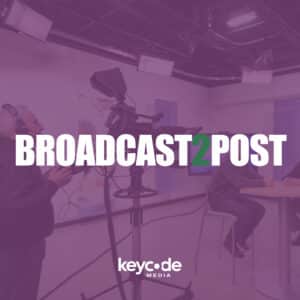
Broadcast2Post | Podcast by Key Code Media
Podcast studios are showing up everywhere. Corporate offices, universities, marketing departments, and internal communications teams look for new ways to create engaging video and audio content. But these spaces no longer need the scale or complexity of a traditional broadcast facility.
Many modern podcast studios are built inside converted conference rooms, meeting spaces, or existing offices. The focus is on creating a professional, flexible environment that supports different types of content while remaining easy to operate for users who may not have a production background.
In this episode of Broadcast2Post, host Michael Kammes is joined by James Tian, CEO of Ikan, and Daniel Napier, Channel Sales Representative at Ikan, to discuss what organizations should consider when building a podcast studio, from room selection and cameras to lighting, audio, IP networking, and the role of automation.
Why Organizations Are Investing in Podcast Studios
Webinars have become a valuable way for organizations to educate audiences, generate leads, and create opportunities for live interaction. Podcasts offer something different. Because the content is available on demand, people can listen to conversations with subject matter experts, company leaders, and industry professionals when it fits their schedule.
That flexibility has made podcasting increasingly useful for organizations that want to build brand awareness and share expertise without turning every piece of content into a formal presentation. A well-produced podcast can give a company a more recognizable voice while creating content that can be distributed across podcast platforms, YouTube, social media, and other channels.
The two formats can also work together. A live discussion can create engagement in the moment, while the recording can continue delivering value afterward as an on-demand podcast, video, or series of shorter clips.
Start With the Room, Not the Equipment
One of the most common mistakes organizations make when planning a podcast studio is starting with the equipment list. Before selecting cameras, microphones, or lighting, it is worth looking at the room itself. The physical environment will have a significant impact on the quality of the finished production, and expensive equipment cannot completely overcome a poor space.
A converted conference room or unused office can make an excellent studio, but the characteristics of the room matter. Glass walls and other hard surfaces can create reflections. Nearby hallways can introduce unwanted noise. Windows can create inconsistent lighting throughout the day, particularly when natural light changes from morning to afternoo.
Acoustic treatment, studio lighting, thoughtful camera placement, and a layout designed around the actual production workflow can make a relatively simple room perform like a professional studio.
It is also important to think about the room as a complete environment. Camera positions, lighting, microphones, seating, backgrounds, displays, and operator work areas should all be considered together rather than added one at a time.
What Does a Budget-Friendly Podcast Studio Actually Mean?
There is no single definition of a budget-friendly podcast studio. What makes sense for one organization may be excessive for another.
The equipment itself is only part of the investment. Installation, configuration, staffing, training, maintenance, and day-to-day operation all contribute to the real cost of a studio.
For example, a highly sophisticated system may look impressive on paper, but it may not be the best choice if every recording requires a dedicated technician. A simpler system that employees can operate themselves may deliver much more value over time.
Before setting a budget, organizations should think about how the studio will actually be used. How many people will typically appear on camera? Will the room be used for audio-only recording, video, or both? Will guests join remotely? Is live streaming part of the plan? Who will operate the system, and how often will the studio be in use?
Those answers should drive the design. The right studio is not the one with the most equipment. It is the one that supports the organization’s production goals without creating unnecessary complexity.
Prioritize Cameras, Lighting, and Audio
Once the room and production requirements are understood, the equipment selection becomes much easier.
For cameras, many podcast environments use anywhere from one to three cameras depending on the format. A single-presenter show can be relatively simple, while an interview or group discussion may benefit from multiple angles.
PTZ cameras have become especially useful for these applications because they can provide several professional-looking camera positions without requiring an operator behind every camera. DSLR and mirrorless cameras can also be a good option when the desired look calls for a more traditional cinematic approach.
Lighting deserves just as much attention. A high-end camera cannot fix poor lighting, and office overhead fixtures are rarely ideal for a professional production. They can create harsh shadows and inconsistent color, while uncontrolled windows can change the appearance of the shot throughout the day.
A basic three-point lighting approach, using a key light, fill light, and backlight, remains a reliable foundation for a fixed studio. The advantage of a dedicated podcast space is that once the lighting is dialed in, it does not have to be reinvented for every recording. Presets can make those settings repeatable and allow users to recall a consistent look with minimal effort.
Audio is equally important, and arguably less forgiving. Depending on the format, a studio might use wired podcast microphones, wireless lavalier microphones, or a combination of both. A properly designed audio system, including the interfaces, mixers, and signal paths behind the microphones, helps ensure that the sound remains consistent from one recording to the next.
That becomes even more important when remote guests are involved. A studio may need to combine local microphones with conferencing platforms such as Microsoft Teams or Zoom while maintaining clean monitoring and recording paths.
Make the Studio Easy to Operate
One of the biggest advantages of a purpose-built podcast studio is the opportunity to simplify the user experience.
The people using the room may be executives, marketing teams, educators, or subject matter experts. They generally do not need to understand every technical detail behind the system. They need to be able to walk in, select the type of recording they are doing, and start creating.
Automation can make that possible. A single control interface could recall camera positions, lighting settings, routing, teleprompter configuration, recording settings, and monitoring. Rather than manually configuring multiple devices before every session, users could select a predefined setup based on what they are producing.
For a two-person interview, for example, the system could move the cameras into position, adjust the lighting for two people, and recall the appropriate audio and monitoring configuration. A single-presenter preset could switch the room to a different framing and lighting setup. A remote-guest preset could prepare the displays, conferencing system, teleprompter, and camera configuration for a conversation with someone joining from another location.
The technology becomes more valuable when it reduces the amount of technical knowledge required to use it. The objective is not to hide the production process, but to make the routine parts of that process repeatable.
Why Podcast Studios Are Moving Toward IP
Another significant change in studio design is the move away from traditional point-to-point infrastructure toward IP-based workflows.
Technologies such as NDI for video, Dante for audio, and Power over Ethernet for connected devices allow production systems to share signals and control information over network infrastructure. Instead of every device requiring a dedicated connection back to a central piece of hardware, more of the system can operate across a common network.
That can make a studio easier to expand and reconfigure as needs change. The same network infrastructure can potentially support PTZ camera control, video routing, audio routing, network-controlled lighting, teleprompter feeds, monitoring, and automation.
For organizations that already have strong internal IT resources, there is another advantage. Network-based production can be built using technologies and concepts that are already familiar to the IT team, which can make ongoing management and support easier.
The Network Still Needs to Be Designed for Video
Connecting production equipment to Ethernet does not automatically mean the network is ready for professional media production.
A studio may have video streams, audio traffic, control data, conferencing, Power over Ethernet devices, and other services sharing the same infrastructure. As the system grows, those requirements can add up quickly.
Larger installations may use dedicated VLANs for technologies such as NDI and Dante, separate production traffic from the corporate network, and provide sufficient PoE capacity for connected endpoints. Higher-bandwidth links between switches may also become important as the number of simultaneous video streams increases.
The physical infrastructure matters as well. Cable category, cable distance, conductor gauge, PoE requirements, and whether the installation needs to meet plenum or other building-code requirements all need to be considered during design.
This is one of the tradeoffs of an IP-based studio. The architecture provides flexibility, but that flexibility depends on having the network properly designed from the beginning.
What Will the Next Podcast Studio Look Like?
The next evolution of podcast studios may not be about adding more equipment. It may be about making the existing technology easier to use.
Automation is already helping studios recall camera positions, lighting configurations, routing, and other settings. AI could eventually extend that capability further by assisting with some of the repetitive tasks involved in production.
For example, future systems could potentially help configure lighting based on the people in the room, automatically adjust audio levels, monitor stream quality, maintain consistent framing, or identify technical problems while a recording is underway. AI could also help prepare a room for a particular type of session before the presenter even arrives.
The goal is not to remove the creative decisions that make a production interesting. It is to reduce the amount of repetitive technical work that can get in the way.
That distinction is important for organizations. The more of the setup and monitoring process that can be automated, the easier it becomes for nontechnical teams to produce professional content without turning every recording into a full-scale production.
The Bigger Shift Is Who Gets to Create
The most important change happening in podcast studio design may have little to do with cameras, microphones, or AI. It is about lowering the barrier between having an idea and turning that idea into something people can actually watch or hear.
When the technology is easier to operate, more people inside an organization can participate in content creation. A product expert can explain a new technology. An executive can discuss an industry trend. An educator can share expertise. A marketing team can create a campaign without needing a production crew for every recording.
That has the potential to turn podcast studios from specialized production spaces into everyday communication tools.
Every organization will have different requirements, and there is no single studio design that fits everyone. The right approach starts with understanding the room, the production goals, the people who will use it, and the infrastructure needed to support it.
Key Code Media helps organizations design, integrate, and support podcast and content production environments built around those requirements. From the initial system design through long-term support, the goal is to create a studio that is not only capable of producing professional content, but practical for the people who actually have to use it.
SUBSCRIBE TO THE PODCAST