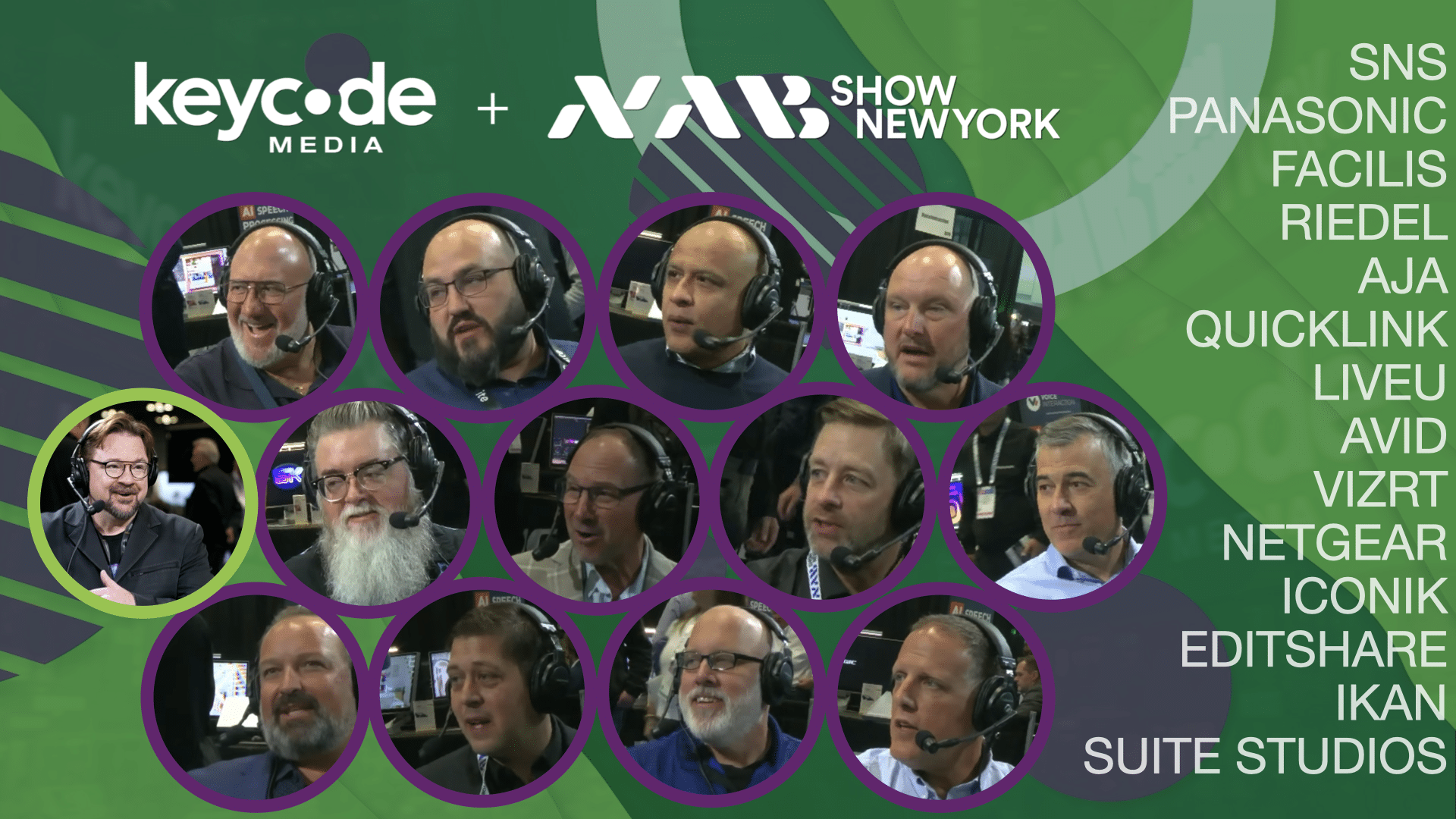
NAB Show New York 2026 brought the broadcast, production, and post-production community together at the Javits Center on October 21–22, and Key Code Media was there to bring the conversations from the show floor directly to you.
Over two days, we sat down with technology leaders from AJA, Avid, EditShare, Facilis, Iconik by Backlight, LiveU, NETGEAR AV, Panasonic, Quicklink, Riedel, Studio Network Solutions, StorageDNA, Suite Studios, Vizrt, and more to take a closer look at their latest announcements, products, and innovations.
From AI-powered media workflows and cloud collaboration to SMPTE ST 2110, AV-over-IP, next-generation PTZ cameras, shared storage, private 5G, and production automation, here’s a recap of what we saw and heard at NAB Show New York 2026.
Watch each of our interviews below for the full conversations from the show floor.
AJA | FS-8 Brings Higher-Density Processing and a Flexible Path to SMPTE ST 2110
AJA highlighted two new products at NAB New York 2026, expanding its openGear ecosystem and advancing its approach to hybrid SDI and IP workflows. The new openGear fiber-optic-to-SDI converter card supports multi-channel 12G-SDI conversion, with configurable transmit and receive capabilities that allow facilities to adapt the card to different signal-routing requirements. A key announcement was the FS-8, the latest evolution of AJA’s well-known FS family of format and signal converters. Built on a modernized platform, FS-8 increases processing density, offering up to four channels of processing in a single unit, while supporting SDI-only, SMPTE ST 2110-only, and hybrid deployments. With an optional SFP providing 25GbE connectivity for ST 2110, the platform gives facilities a practical way to bridge existing SDI infrastructure into IP-based environments and transition at their own pace. ST 2110 adoption is expanding beyond traditional broadcast facilities into large outside broadcast trucks, stadium infrastructure, and production studios, including LED-based broadcast and film environments. Key Code Media can help customers evaluate AJA solutions for signal conversion, infrastructure upgrades, and phased transitions from SDI to ST 2110.
Watch the AJA Interview:
Avid Technology | Content Core, AI-Powered Workflows & Connected Media Composer Editing
Avid CTO Tom Sharma shared how Avid is evolving its product ecosystem around Content Core, a foundation designed to connect media applications, customer media, and production workflows across on-premises infrastructure and the cloud. Rather than requiring customers to move their high-resolution media into the cloud, Content Core can centralize proxies and metadata to enable powerful search capabilities, including frame-level visual recognition, closed captions, and audio transcription, leveraging Avid’s partnership with Google Gemini. A major focus is moving beyond AI as a standalone feature toward AI agents that turn creative intent into action. Avid’s new Ready to Edit capability, for example, can take a request such as creating a sports highlights package, find relevant media, organize it into a collection, and open it in a Media Composer bin ready for editing. Avid is also developing a web-based version of Media Composer that interoperates with the desktop application, allowing editors to begin work in the cloud and continue on their local workstations while maintaining centralized security and access controls. Looking ahead, Avid is working toward broader storage interoperability and introducing Site Engine, software designed to connect on-premises or customer-managed cloud media with centralized search, editing, and distribution workflows. Key Code Media can help customers evaluate Avid’s evolving ecosystem, from Media Composer and shared storage to AI-assisted media discovery and hybrid post-production workflows.
Watch the Avid Interview:
Broadfield Distribution | Corporate Video, Simplified Production & the Convergence of Broadcast and AV
Broadfield Distribution’s Gary highlighted several industry trends that emerged at NAB New York 2026, particularly the growing demand for professional-quality video in corporate environments. As broadcast and AV continue to converge, businesses are moving beyond standard video conferencing toward dedicated corporate studios, executive presentation spaces, and sales training environments that deliver polished video, professional graphics, and high-quality audio. Ease of operation is becoming just as important as production quality, with tools such as Elgato Stream Deck and improved control interfaces allowing nontechnical users to operate sophisticated production systems with minimal training. Broadfield is also seeing creators and influencers invest in multi-camera production, PTZ cameras, and affordable switching systems to elevate their content and grow their businesses. In live production, advances in PTZ camera image quality, global shutter technology, and higher-frame-rate capture are creating new opportunities for sports, particularly smoother instant replays and cinematic-style shots that add production value without changing the entire broadcast format. Meanwhile, AV-over-IP continues to gain traction beyond traditional broadcast, with growing interest in IP-based infrastructure, purpose-built network switches, and stronger security controls as video systems become more connected to enterprise IT networks. Across these markets, the common theme is making professional video more accessible, reliable, and easier to operate. Key Code Media helps organizations bring these trends together through integrated broadcast, AV, and corporate video solutions, from automated production systems and PTZ cameras to IP-based infrastructure and streamlined control workflows.
Watch the Broadfield Distribution Interview:
EditShare | On-Prem AI Search, Hybrid Cloud Media Management & Cost-Effective Workflows
EditShare’s Brad Turner discussed how the company is adapting to three major industry challenges: increasingly distributed media across on-premises storage and cloud environments, rising hardware costs, and demand for practical, cost-effective AI. To support production and post-production teams working across multiple offices and remote locations, EditShare is expanding its software capabilities for managing media and workflows across distributed environments. MediaSilo is evolving beyond review and approval into a broader hybrid-cloud search and media management platform, enabling users to discover, access, and move assets across multiple S3 storage buckets and connected services. EditShare is also extending its Flow workflow automation and AI search capabilities so they can operate independently of EditShare storage hardware, allowing customers to search and move media without replacing their existing storage infrastructure. A major focus is on on-premises AI processing, with support for 70 languages and an all-you-can-process model designed to provide predictable costs while keeping media local. Through a vector database and API integrations using the Model Context Protocol (MCP), Flow can make analyzed media information, including transcripts, scene descriptions, and logo detection, available to AI assistants such as Claude and ChatGPT without requiring those models to access the original media directly. These developments reflect a broader shift toward flexible media workflows in which AI can help users discover and act on content through natural-language requests rather than navigating complex software interfaces. Key Code Media can help customers integrate EditShare storage, MediaSilo, and Flow to build more connected media management, AI search, and automation workflows while making the most of existing infrastructure.
Watch the EditShare Interview:
Facilis Technology | FastTracker 3.8.6, Media Composer Integration & Smarter Storage Management
Facilis Technology’s Jim McKenna highlighted the continued expansion of FastTracker, including the upcoming 3.8.6 release and a new Avid Media Composer panel developed through Facilis’ work as an Avid SDK and beta partner. The integration allows editors to search the entire FastTracker database directly from Media Composer, including media across projects, Facilis storage, network storage, and even Avid NEXIS, with support for metadata, markers, linking, and transcoding on import. Beyond search, FastTracker has matured into a broader automation and asset management platform, using metadata as workflow triggers to automate processes such as approvals, AI analysis, proxy generation, archive, and delivery. It also supports on-premises transcription, Google Vertex/Gemini AI-assisted metadata enrichment, and proxy workflows integrated with Adobe Premiere Pro and DaVinci Resolve. As SSD, hard drive, and LTO costs continue to rise, Facilis is also seeing customers rethink how media is distributed between high-performance primary storage, nearline systems, LTO, and other NAS tiers. FastTracker can provide the orchestration layer across those environments, automatically moving aging or infrequently used content off Tier 1 storage while keeping assets indexed and searchable. Key Code Media can help customers design Facilis environments that combine collaborative shared storage, FastTracker media management, AI-assisted search, and automated tiering to control storage costs without adding unnecessary workflow complexity.
Watch the Facilis Technology Interview:
Iconik by Backlight | Natural Language Search, Open AI Integration & ISG Pro
Jeremy Strootman from Backlight highlighted how Iconik is expanding its hybrid media management platform with more flexible AI integrations, natural-language search, and new tools for managing large on-premises media libraries. Iconik already provides built-in capabilities including speech-to-text, translation, and facial recognition, but the platform is becoming increasingly open to customer-selected AI models, allowing organizations to combine Iconik’s technical and business metadata with specialized AI tools while using the Iconik interface for search and discovery. Backlight has also launched an MCP server for Iconik, allowing users to interact with MAM data through tools such as Claude, Copilot, and Gemini using natural language. This creates new opportunities to analyze storage usage, understand user activity, forecast cloud costs, and eventually trigger media workflows without exposing the original media directly to the AI assistant. For organizations maintaining large on-premises libraries, Backlight also introduced ISG Pro, a more scalable version of the Iconik Storage Gateway that distributes indexing and proxy processing across multiple servers or virtual machines, providing faster indexing and greater redundancy for large NAS and petabyte-scale environments. Together, these updates reinforce Iconik’s storage-agnostic approach, allowing media to remain on-premises, in the cloud, or across both while giving teams a unified layer for discovery, management, and automation. Key Code Media can help customers deploy Iconik across hybrid storage environments and integrate AI search, ISG Pro, archive, and workflow automation into existing creative infrastructure.
Watch the Iconik by Backlight Interview:
Ikan | PoE Lighting, Network Control & NDI-Powered Studio Tools
Ikan highlighted how Power over Ethernet (PoE) is simplifying the design and deployment of broadcast, corporate, education, and podcast studios by combining power and network control over a single Ethernet connection. Its expanding PoE lighting lineup includes fixtures ranging from compact studio lights to larger fixtures designed for cycloramas and chroma key environments, eliminating the need to run traditional electrical power to every lighting position. Ikan’s Light Control Software V2 adds centralized network management, allowing users to discover fixtures and remotely configure IP addresses, DMX addresses, names, and other settings. The same single-cable approach is expanding into monitoring and prompting, with Ikan demonstrating an NDI and PoE-powered 19-inch monitor alongside its RT419 teleprompter and developing additional PoE prompter monitors that receive both power and video over Ethernet. Ikan is also maintaining support for legacy HDMI, SDI, component, VGA, and composite sources, helping facilities transition toward IP without immediately replacing functioning equipment. The broader trend is making it easier to convert ordinary offices, classrooms, and conference spaces into professional production studios without installing traditional lighting grids or extensive electrical infrastructure. Key Code Media can help customers integrate Ikan PoE lighting, teleprompters, monitoring, and network control into new or existing studios, reducing cabling and simplifying the transition toward IP-based production.
Watch the Ikan Interview:
LiveU | LU900Q, LiveU IQ, Nexus & Story-Centric Cloud Ingest
LiveU’s Ben Ratner highlighted the company’s expanding ecosystem for field contribution, IP video, and cloud-based production, led by the new LU900Q bonded cellular encoder. Built from the ground up, the LU900Q adds 4:2:2 10-bit HDR, dual inputs and outputs, IP and USB connectivity, and support for workflows such as program video, teleprompter, and wireless IFB. LiveU is also expanding the intelligence behind bonded cellular with LiveU IQ, which dynamically evaluates available cellular providers and shifts connectivity toward the strongest available networks, improving reliability in both crowded events and remote environments. Beyond field encoding, the new LiveU Nexus expands LiveU into a more open IP contribution platform, allowing teams to bring in and route sources including web browsers, Zoom and Microsoft Teams calls, SRT, RTMP, and other digital feeds through the cloud. LiveU Ingest extends that workflow into production and post by recording incoming feeds as live growing files, connecting them with MAM, storage, and newsroom systems, and carrying story metadata throughout the workflow. Real-time transcription also allows producers and editors to immediately search incoming interviews, press conferences, and breaking-news feeds without waiting for media to finish recording or upload. Key Code Media can help customers integrate LiveU from field acquisition and bonded cellular contribution through cloud routing, newsroom workflows, MAM integration, and live production.
Watch the LiveU Interview:
NETGEAR AV | M4350 Switches, ST 2110 & Smarter AV-over-IP Management
NETGEAR AV highlighted the continued expansion of its professional AV networking portfolio, including the M4350 switch family designed for increasingly demanding AV-over-IP and broadcast environments. Building on the M4250 platform, the M4350 line adds higher-bandwidth options and expanded support for SMPTE ST 2110, including switches with built-in boundary and grandmaster clock capabilities and simplified profiles that allow integrators to configure ports for ST 2110 without becoming network experts. The portfolio now extends up to a 16-port 100GbE switch, opening NETGEAR to larger video and broadcast applications, while new ruggedized options address rental, staging, lighting, and live production environments. NETGEAR is also expanding NETGEAR Engage beyond switch configuration with a dedicated compute appliance that enables remote network management and is being developed as an application platform for third-party monitoring, control, NDI, and workflow tools. With an ecosystem of more than 600 AV and broadcast partners, NETGEAR continues to build manufacturer-specific profiles that simplify configuration and improve interoperability across cameras, audio, intercom, control, and production systems. For larger networks, NETGEAR can also operate at the edge alongside higher-capacity Cisco or Arista core infrastructure, giving facilities another path toward scalable IP deployments. Key Code Media can help customers design and validate NETGEAR-based AV-over-IP and ST 2110 networks, from PoE-powered studios and production systems to high-bandwidth broadcast infrastructure and centralized network management.
Watch the NETGEAR AV Interview:
Panasonic | New 200 Series PTZ Cameras, Global Shutter & Native ST 2110
Panasonic introduced a new class of professional PTZ cameras with its 200 Series, bringing several significant upgrades aimed at broadcast, sports, corporate, and live production environments. Headlining the new lineup is what Panasonic describes as the world’s first professional PTZ camera with a global shutter, designed to reduce motion distortion when capturing fast-moving subjects and improve performance when shooting against LED walls. Panasonic is also bringing 25GbE SMPTE ST 2110 connectivity to select models, supporting uncompressed 4K video alongside built-in Dante audio and redundancy through ST 2022-7 and Dante. Two models also introduce a rotating lens mechanism for native 9:16 vertical production, allowing teams to capture higher-resolution vertical content for social platforms without relying on cropping a traditional 16:9 image. Built from the ground up, the new cameras also offer significantly faster PTZ movement, with Panasonic claiming speeds up to nine times faster than its current UE160 while the global shutter helps maintain image quality during rapid movement. The first models in the 200 Series are expected to ship in February 2027, followed by the rotating-lens models in June. Key Code Media can help customers integrate Panasonic’s latest PTZ cameras into SDI, ST 2110, Dante, sports, studio, and vertical-content workflows while designing the network and control infrastructure required to support them.
Watch the Panasonic Interview:
Quicklink | StudioEdge, Multi-Platform Remote Guests & Simplified Town Hall Production
Quicklink highlighted the continued expansion of StudioEdge, its dedicated hardware and software platform for bringing remote guests into professional live productions. StudioEdge already supports contribution from Microsoft Teams, Zoom, and Quicklink’s StudioCall platform, with Quicklink announcing plans to add Cisco Webex and WhatsApp, giving production teams access to five major contribution platforms from a single system. Quicklink also previewed a new solution currently referred to as Town Hall, a web-based interface built on top of its live production switching technology and designed to simplify corporate meetings, city council sessions, and similar productions. The platform will allow operators to visually configure participants, automate elements such as lower thirds, and use AI-assisted features through a touchscreen-friendly interface that reduces the technical knowledge required to run a production. Underpinning these newer products is Quicklink’s more than 20 years of experience supporting major broadcasters, with the company now bringing broadcast-grade technology and support into corporate, education, government, and house of worship environments where customers need professional production capabilities without traditional broadcast complexity. Key Code Media can help customers integrate Quicklink for remote guest contribution, live switching, automated meeting production, and hybrid corporate or government video workflows.
Watch the Quicklink Interview:
Riedel Communications | Private 5G, Bolero Mini & Next-Generation Intercom
Riedel Communications’ Matt Bain highlighted a major expansion of the company’s communications ecosystem, beginning with a new private 5G system designed specifically around the high upload-bandwidth requirements of content creators, stadiums, sports facilities, and live production environments. Riedel also introduced significant updates to its core intercom portfolio, including Artist 9.0, the new Bolero Mini, which reduces the size and weight of the traditional Bolero wireless beltpack, and an entirely new headset family that turns the headset itself into an intelligent endpoint with buttons capable of triggering communications, controls, and production automations. Riedel is also extending its SmartPanel concept with a Virtual SmartPanel, bringing communications and third-party control functionality onto smartphones through a Kubernetes-based backend. Because these workflows can extend beyond a facility’s firewall and onto public networks, Riedel is taking a security-first approach with dedicated infrastructure designed to provide secure remote communications. Together, these developments point toward a more connected Riedel ecosystem where intercom, wireless connectivity, control, and automation increasingly work together as part of the broader production workflow. Key Code Media can help customers integrate Riedel Artist, Bolero, private 5G, SmartPanel, and virtual communications into broadcast, sports, live production, and distributed production environments.
Watch the Riedel Communications Interview:
StorageDNA | DNAfabric 2600, AI-Driven Data Intelligence & Fabric Lite
StorageDNA highlighted how DNAfabric is evolving beyond data movement and archive into a broader intelligence layer for media stored across primary storage, nearline systems, LTO, disk, and cloud. The new DNAfabric 2600 creates a context-aware index across these storage environments, giving organizations a single view of where assets live, how many copies exist, when content has moved or been restored, storage health, and the costs associated with different storage tiers. StorageDNA is extending that intelligence through MCP integration, allowing users to query DNAfabric using natural language through AI tools such as Claude, Gemini, ChatGPT, or locally hosted models while maintaining configurable access guardrails. New Media Intelligence panels for Adobe Premiere Pro, DaVinci Resolve, and Avid Media Composer bring search, asset location, and restore capabilities directly into editorial workflows. StorageDNA is also introducing an Action Framework designed to turn this intelligence into automated workflows, allowing metadata tags or other conditions to trigger actions across storage and production systems. For smaller environments and existing Evolution customers, the new Fabric Lite brings deduplication analysis, hot/cold storage insights, cost metrics, and LTO and disk archiving into a significantly smaller hardware footprint that can run on systems such as a Mac mini or Intel NUC. Key Code Media can help customers deploy DNAfabric to gain visibility across fragmented storage environments, automate data movement, improve archive strategy, and connect storage intelligence directly with editorial and AI-driven workflows.
Watch the StorageDNA Interview:
Studio Network Solutions | AI Suite, Outpost, Trio & Smarter EVO Workflows
Studio Network Solutions (SNS) highlighted several additions to its ecosystem focused on on-premises AI, predictable costs, review and approval, and automated media movement. SNS continues to expand its AI Suite, adding agent-based services and LLM capabilities that can analyze media, enrich metadata, recognize faces, voices and text, and begin performing tasks such as assembling rough cuts and rendering clips. The platform can run on-premises at a flat, predictable cost without token-based processing fees and can analyze media across SNS storage, other connected storage systems, and cloud libraries. SNS is also expanding Outpost, its $99-per-month unlimited-user review and approval platform, with an Adobe Premiere Pro panel that brings comments directly into the editing timeline. For archive, Trio provides an SNS-native S3 storage endpoint with flat-rate pricing and no traditional ingress or egress fees, while updated EVO SSD systems deliver up to 40% greater performance through hardware and software improvements. Across the broader EVO ecosystem, tools such as ShareBrowser and Slingshot help automate media movement between high-performance storage, spinning disk, cloud, archive, and services including S3, Google Cloud, Azure, SMB, FTP, SFTP, Dropbox, and OneDrive. Key Code Media can help customers design SNS workflows that combine EVO shared storage, AI-powered media discovery, review and approval, automated data movement, and cloud archive into a scalable creative environment.
Watch the Studio Network Solutions Interview:
Suite Studios | Native S3, Cloud Editing & Frame.io Drive
Suite Studios highlighted its new Native S3 functionality, giving creative teams and production applications more flexible ways to interact directly with cloud storage. Suite can continue to present cloud storage to editors as a familiar mounted drive while applications, automations, and other services simultaneously read and write directly to the underlying S3 bucket. This allows organizations to integrate Suite into existing infrastructure without forcing media through a proprietary storage layer, while editors can work with cloud-hosted media as though it were sitting on a local NAS. Suite also highlighted its partnership with Adobe, with Suite technology powering the underlying mounted-drive experience for Frame.io Drive. Because Suite appears as a standard drive to creative applications, the same approach can support workflows with Adobe Premiere Pro, DaVinci Resolve, Avid Media Composer, MAM platforms such as Iconik, and other production tools. Native S3 also creates new possibilities for existing cloud archives, allowing organizations to point Suite at an established S3 bucket and make previously archived or backup content immediately accessible for editing without first re-ingesting or moving the entire library. Key Code Media can help customers integrate Suite Studios with cloud storage, shared editorial workflows, MAM platforms, and tiered storage strategies to give distributed creative teams faster access to media without traditional upload-and-download workflows.
Watch the Suite Studios Interview:
Vizrt | TriCaster AI Keying, New Hardware & LivePanel Pro
Vizrt’s Jeremy Morris highlighted several major updates across the TriCaster ecosystem, including new AI-powered production capabilities, simplified hardware options, and significantly expanded control and automation. Vizrt is bringing its AI-powered subject isolation technology into TriCaster Vizion, allowing producers to separate talent from virtually any background without a traditional green screen or extensive camera calibration. The system can optically train on a camera in about 30 seconds, opening virtual production and compositing workflows to studios, corporate environments, and smaller production spaces. Vizrt has also streamlined the TriCaster lineup around new rackmount hardware, including TriCaster Mini, TriCaster Prizm, and TriCaster Vizion, with flexible SDI and NDI configurations that can be adapted for each production. LivePanel Pro adds another major workflow improvement, introducing bidirectional feedback, live video monitoring, tally, variables, macros, embedded web pages, user permissions, and customizable interfaces that can simplify sophisticated productions for less-technical operators. These tools allow integrators to create purpose-built control experiences where an operator, executive, or talent can access only the functions they need while still receiving confirmation that commands have actually been executed. Key Code Media can help customers integrate TriCaster, NDI, AI-assisted production, LivePanel Pro, cameras, graphics, and automation into flexible live production environments that are powerful behind the scenes but simple for operators to use.
Watch the Vizrt Interview:
Key Code Media | Industry Trends, Major Projects & 25 Years of Integration
Key Code Media founder Mike Cavanagh reflected on the technology trends shaping broadcast, AV, and media production while celebrating the company’s 25th anniversary. One of the biggest themes was continued convergence, as video increasingly intersects with IP networking, IT infrastructure, AI, and automation. Rather than viewing technology choices as cloud versus on-premises or SDI versus IP, Key Code Media is seeing customers adopt hybrid approaches based on workflow requirements and financial return. Cloud continues to make sense for collaboration, archive, and burstable capacity, while technologies such as SMPTE ST 2110 and NDI are expanding the flexibility of IP-based production. AI is also beginning to change how users interact with increasingly complex systems, with natural-language interfaces and MCP-based tools making it possible to search media, analyze infrastructure, and eventually control workflows without learning every underlying application. Cavanagh also highlighted recent Key Code Media projects, including a new ST 2110 broadcast facility for Arizona Public Media and a massive 50-by-150-foot LED video wall in Ontario, California, featuring more than 380 panels. These projects reflect how Key Code Media has evolved since its founding in 2001, expanding from post-production into broadcast, AV, structured cabling, networking, and enterprise media workflows. Today, the company has grown from 22 employees and two offices to approximately 180 employees across 10 locations, with an increasing focus on helping customers determine not simply what technology is possible, but what technology makes financial and operational sense for their organization.
Watch the Key Code Media interview: